
Ankle Sprains in Football: Grades and Return Timelines
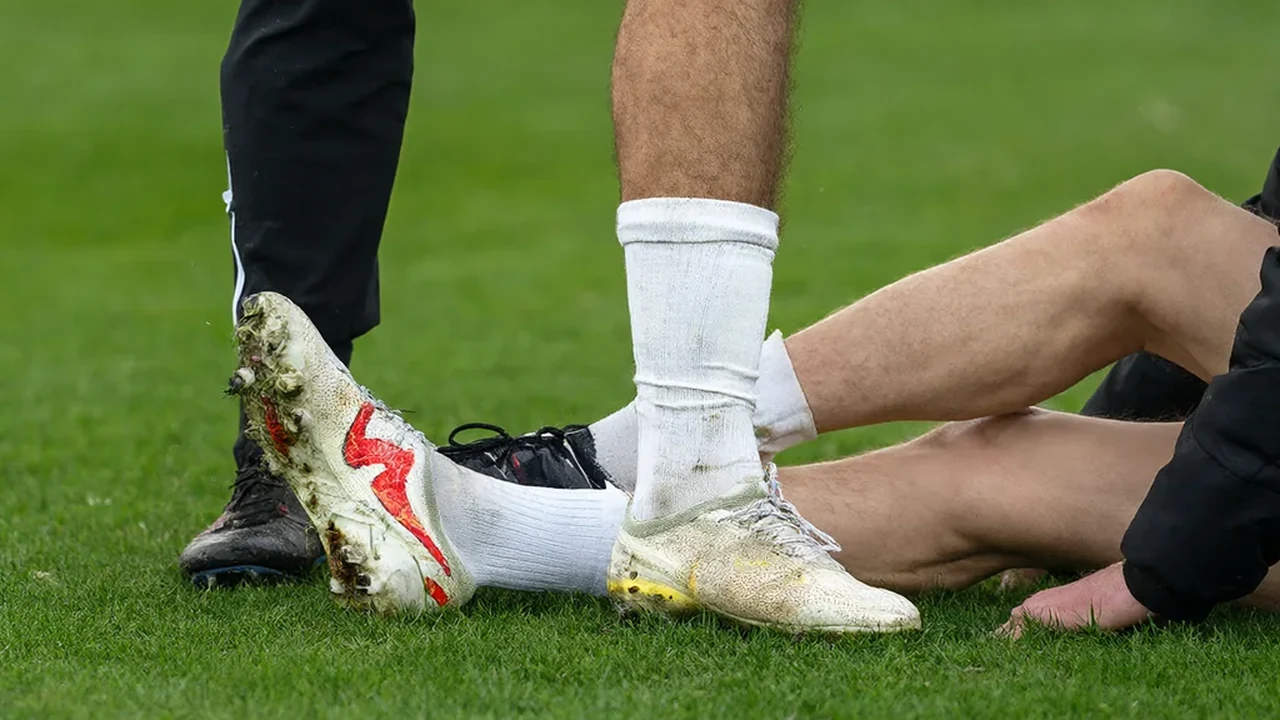
An ankle sprain is the injury that never leads a bulletin and yet turns up in team news almost every week. A full-back rolls over the outside of his foot in a 50-50, hobbles off, gets strapped, and then disappears for a month. The mechanism is nearly always the same. The foot turns inwards, the ligaments on the outside of the joint are stretched past their limit, and the medical staff have to establish how much of that ligament complex is torn before anybody can honestly put a date on a return.
That is why two players with the same word on the injury report can be out for very different lengths of time. A sprain describes a mechanism, not a severity. Until the grade is known, any return date is a guess dressed up as information, and this is exactly where supporters, fantasy managers and even journalists get caught out.
Why the ankle is exposed in football
The lateral ligament complex on the outside of the ankle does the work of a hinge and a brake at the same time. The anterior talofibular ligament is the first structure to fail in an inversion injury, followed by the calcaneofibular ligament in more severe cases. Football loads that complex constantly: landing from headers, decelerating before a cross, changing direction on a surface that grips, and challenging for a ball with one foot planted. Add a previous sprain and the risk rises sharply, because stretched ligaments and altered balance responses make the next roll more likely. Clubs therefore treat even a low-grade sprain as a strength and proprioception problem, not just a swelling to be iced.
What grade 1, 2 and 3 actually mean
The three-grade classification is clinical and simple. Grade 1 is a stretch with no meaningful laxity and no loss of function. Grade 2 is a partial tear with mild to moderate laxity, swelling and pain on weight bearing. Grade 3 is a complete tear with clear instability. Some clubs use language such as low-grade or grade 1 plus, which is not a formal category and usually signals that the scan sat between two grades. When a bulletin says the player is awaiting scan results, no grade exists yet, and that is worth remembering before anyone quotes a return date.
Typical absence by grade
The ranges below are the ones most often quoted in sports medicine guidance and used inside club medical departments for a first estimate. They describe the middle of a distribution, not a promise for an individual player, and the final call belongs to the medical staff and the player's response to loading.
| Grade | Ligament damage | Typical absence | Main risk in the weeks after |
|---|---|---|---|
| Grade 1 | Stretch, no laxity | 1 to 3 weeks | Returning before balance and calf strength are restored |
| Grade 2 | Partial tear, mild to moderate laxity | 3 to 6 weeks | Swelling that returns with running load |
| Grade 3 | Complete tear, clear instability | 6 to 12 weeks | Repeat sprains and chronic instability |
| High ankle (syndesmosis) | Injury between tibia and fibula, not the lateral ligaments | 6 to 10 weeks, sometimes longer | Slow weight-bearing progress, prolonged pain on push-off |
Read that table as a set of brackets rather than a countdown. A grade 2 sprain in a centre-back who has to head and clear under contact can take longer than a grade 2 in a winger whose game is straight-line running. Age, previous injuries and the number of games the club needs to win in the next month all push the decision one way or the other.
The high ankle sprain is a different injury
The syndesmosis injury is routinely lumped in with lateral sprains and should not be. It involves the joint between the tibia and fibula above the ankle, usually through external rotation rather than pure inversion. Players often describe pain higher up the leg, and the tell-tale sign is discomfort when the foot is pushed outwards or when the leg is loaded in a lunge. These injuries are slower, they can require surgery when the joint is unstable, and a club that says only "ankle" without further detail has told you very little. If the words high ankle or syndesmosis appear, add weeks to whatever your instinct suggested.
Why the same ankle goes again
Recurrence is the part of the story that does not fit the headline. After a lateral sprain, the ligaments are looser, the receptors that report joint position are less accurate, and the calf and peroneal muscles have to compensate. If a player returns when the swelling has gone but the strength and balance work is incomplete, the ankle is vulnerable in exactly the situation that caused the first injury. That is why clubs insist on single-leg hop tests, balance work and change of direction drills before contact training. It is also why the phrase "back in training" should never be read as "available for selection".
What a realistic return looks like
- Days 1 to 3: protection, compression, controlled movement and pain management. No timeline is set.
- Week 1 to 2: restore range of motion and normal walking, begin isometric strength work.
- Week 2 to 4: progressive loading, balance and proprioception, straight-line running once walking is pain-free.
- Week 3 to 6: change of direction, jumping and landing, sport-specific drills with the ball.
- Final stage: full contact training, then a selection decision based on the position and the match.
The final stage is where predictions usually fail. A player can complete every drill and still be left out for a game because the bench has other priorities or because the manager wants a full week of contact before risking him.
How to read an ankle injury update
Scan awaited means there is no grade and no date. In a protective boot means the club is limiting load, not that the injury is severe. Running on grass means the player is past the halfway point of a typical grade 2. Assessed late means a fitness test on matchday, which is a coin flip dressed as news. When a club says there is no timescale, believe it: the return date is genuinely not confirmed, and any specific number in a preview is somebody's estimate. The same logic applies to grading language in other muscle injuries, which is why the grade framework in our hamstring grades and timelines guide is a useful companion. For the injuries that remove a player for months rather than weeks, the mechanics are covered in the long road back from ACL surgery.
Related analysis
Injury round-up: what clubs said after the October break
Six clubs, one weekend, and very few return dates: what the October injury updates actually said.
2026-10-18
How to read club injury statements
A practical decoder for the phrases clubs use, from out for weeks to no timescale at all.
2026-10-18
FPL flags and chance of playing explained
Yellow, orange, red: how FPL percentages are set and what to do with a 25 per cent flag.
2026-10-18
European nights, rotation and recurrence risk
Three games in seven days is where hamstrings go: load, rest and rotation before Europe.
2026-10-18